Cardano wrote freeze and seizure into its token standard, Tether froze a payments firm's working capital for 378 days with no court order, and Spain re-approved rent decrees its parliament had just rejected. Three faces of one mechanism: the rules now travel with the asset.
7 Oct 20263,564 words · 15 minAlso on Nostr as a long-form note
Three announcements in three days, and they are the same announcement.
On 7 October the Cardano Foundation said its new token standard, CIP-0113, was live on mainnet. The announcement was made at TOKEN2049 in Singapore. It lets a token issuer freeze and seize assets on the ledger, with compliance checks executed on every transfer, mint and burn, and no hard fork required. On 5 October a cross-border payments company called Conduit Technology sued four Tether entities in the Southern District of New York. The dispute is over 2.76 million dollars that Tether removed from Conduit's operating wallet on 24 September 2025 and has not returned. On 6 October the Spanish cabinet re-approved two housing decrees that the full congress had rejected four days earlier. It dissolved parliament first, then moved the vote into a caretaker body that still had the numbers.
The three cases look unrelated. An altcoin wants institutional business, a stablecoin issuer wants to look like a bank, a government wants cheaper rents. The mechanism underneath is one thing. Control over a claim is migrating out of the institution that holds it and into the asset itself, where the terms are written in advance and carried out mechanically at every move. Once the rules travel with the asset, the exit has to be negotiated with the rulebook instead of with a manager.
That is the week's real news. Two of the three experiments are running on numbers anyone can check, and they are worth taking apart.
Two percent against 4.9 percent
Spain's Council of Ministers approved Real Decreto-ley 26/2026 and Real Decreto-ley 27/2026 on 29 September, and they took effect within days. The first caps rent increases. Where a lease already sits above the official reference-price ceiling, the landlord may not raise the rent at all. Everywhere else, absent a new agreement between the parties, the increase cannot exceed 2 percent. Spain's national statistics institute put September inflation at 4.9 percent in the flash estimate published the same week.
A landlord charging the legal maximum therefore loses ground by law. The gap is 2.9 percentage points of purchasing power per year. Compounded, it reaches 15.0 percent across a five-year renewal and 21.7 percent across the seven-year term a corporate landlord must now grant [own calculation from the two published figures]. The second decree removes the landlord's ability to end a tenancy without a listed cause. Where that cause is missing, the landlord owes at least one month of rent for every year of occupancy. Both decrees reach backward into contracts already signed, from their next renewal date. Tax incentives for renting at regulated prices and restrictions on corporate purchases through 2028 are attached to the same package.
Then came the procedural part. Congress rejected the first decree 178 to 172 and the second 184 to 166 on 2 October, with Junts per Catalunya joining the opposition. Prime Minister Sánchez dissolved parliament and called a snap election for 29 November. On 6 October the cabinet re-approved both texts with what it described as technical changes. It routed them to the Diputación Permanente, the 69-seat body that acts while the full congress is dissolved. There the arithmetic is more favourable. State broadcaster TVE expects the first decree to pass there; the government has conditioned the second one's effect on that validation.
Read that sequence without the politics. A measure was voted down by the elected chamber, the chamber was dissolved, and the measure returned through a smaller body that the same government convenes. Whatever you think of rent caps, the lesson for anyone who holds wealth in a domestic real asset is about procedure, not price: a contract between two private parties does not outlast a cabinet meeting.
How the market answered is reported but not audited. Spanish outlets cited roughly 2,900 rental listings pulled from property portals within four hours of the announcement, with Madrid listings down about 20 percent inside a day. Those are directional counts from early, unaudited reporting, and I treat them as such. The precedent is better documented. From 1946 to 1985 Spain forced near-permanent lease extensions and froze rents for decades; owners stopped maintaining buildings and the centres decayed until the Boyer decree dismantled the system in 1985. San Francisco's 1994 rent-control expansion, studied by Diamond, McQuade and Qian in NBER Working Paper 24181, cut regulated housing supply by 15 percent and raised citywide rents by 5.1 percent. Berlin's 2020 freeze was struck down by the constitutional court in 2021. The policy keeps producing the same data, and the data keeps being ignored because the intention is laudable.
The rules travel with the asset
Cardano's CIP-0113 is the opposite kind of claim, and for that reason the more interesting one. The Cardano Foundation announced it on 7 October from Zug, at TOKEN2049 in Singapore. The standard embeds a freeze-and-seize substandard in the native token transfer logic, built on denylist-aware transfers and issuer-controlled on-chain denylist management. Authorised parties can move tokens without the holder's consent when that power is written into the token's rule set. Issuers can also update the compliance modules as regulation changes, which means the permission set is not fixed at issuance.
Chief executive Frederik Gregaard gave the logic its cleanest formulation to CoinDesk: the rules have to travel with the asset and be enforced every time it moves. That sentence is the whole design. It also happens to describe precisely what a bearer instrument is not.
The Swiss Capital Markets and Technology Association has recognised CIP-0113 as equivalent to its CMTAT framework, the standard used to certify equity securities on-chain in Switzerland. That places the token in the infrastructure lane for regulated stablecoins, tokenised funds and bonds rather than in the experimental one. The Foundation's own release cites the BIS and the IMF as having identified ledger-level programmability as central to the next generation of tokenised financial markets. I have not read that release directly, only tftc's account of it, and I flag that in the closing section.
The detail worth keeping is a collateral one, because Cardano's accounting model packs several assets into a single unspent output. A freeze applied to one CIP-0113 token in a shared output can obstruct access to everything else sitting in that same output, including plain ADA held by someone with no exposure to the regulated token at all. The Foundation has documented an "unfracking" mechanism that lets a holder split each policy into its own output. That edge case is the thesis in miniature: permissioned logic does not stay in the lane you designed for it.
There is a difference of degree that matters. Circle can blacklist an address inside its own USDC contract on Ethereum; that is one issuer's tool inside somebody else's machine. CIP-0113 is a chain-wide rule set that any issuer on Cardano can adopt, enforced by the ledger on every movement. One is an exception, the other is a default.
The falsifiable version of the concern is simple, and the author of the original analysis states it himself. If no regulated issuer deploys under CIP-0113 over the next twenty-four months, the seizure infrastructure exists only on paper and the worry is academic. Watch for a named stablecoin, fund or bond issuer, and watch whether compliance logic ever migrates toward general-purpose Cardano assets rather than staying confined to explicitly permissioned products. That is the line.
The same week, in Berlin, the ecash crowd moved in the opposite direction. At Ecash Hackday on 30 September a single Fedimint federation ran across three independent implementations, built by the Cashu developer known as thesimplekid, by Eric Sirion, and by the Fedimint core team. The following morning at bitcoin++ Calle presented Federated Cashu: a 4-of-5 threshold federation on a blind BLS signature scheme, so any four of five operators keep the mint alive. Fedi co-founder Obi Nwosu described the problem they were fixing as a software monoculture: every guardian on earth ran identical code, so one critical bug could sweep the entire protocol surface at once. He cited the Coldcard entropy failure and the Liquid federation drain as examples of what that costs. Three codebases in one federation is a small event with a large meaning: independent failure domains at the software layer. That is not custody that cannot fail, it is custody that cannot fail all at once.
A year is not a freeze, it is a taking
Now the stablecoin. Conduit Technology's complaint, filed on 5 October in the Southern District of New York, describes a wallet holding 2.76 million dollars in USDT as the equivalent of the company's operating bank account. It states that Conduit owes Tether nothing. Tether's internal T3 Financial Crime Unit froze the wallet on 24 September 2025. As of 7 October the freeze has held for 378 days.
The timeline in the complaint is the part that matters. Tether acted in connection with a Brazilian Federal Police investigation into Onix Intermediações, a former Conduit customer. Onix last used Conduit's platform in April 2025. Conduit's treasury wallet was created on 20 May 2025 and never held Onix funds. Brazilian law enforcement confirmed it never flagged the Conduit wallet, and a Brazilian court confirmed Conduit was not under investigation in the Onix case. No court order directed Tether to freeze this wallet. Conduit received no notice and, on the complaint's account, had no route to recourse except federal litigation.
Conduit asks for four things. A declaration that Tether lacked the authority to freeze. An order to unfreeze the wallet. At least 2.76 million dollars in compensatory damages. And the profits Tether earned on the reserves backing the frozen tokens. That last item is the sharp one. Tether holds Treasury bills against issued USDT, and those instruments keep paying whether or not a particular wallet is switched off. The holder is locked out of working capital for a year while the issuer keeps the float. The complaint's implied exposure runs past five million dollars before reserve income is counted.
This is the second such suit in five weeks. In late August 2026 two Thai businessmen filed in the same court alleging a 42.4 million dollar freeze on an informal request from a federal agency, with the warrant arriving afterwards. Both complaints target the same mechanism. A private compliance unit, with no law-enforcement standing, acting on requests that may or may not be orders. Against a wallet that belongs to somebody who was never charged with anything.
The threshold question is whether Tether can produce a valid legal order specifically directing the freeze of the Conduit wallet. If it can, this is a compliance dispute about whose paperwork was late. If it cannot, a federal judge gets to decide whether a private company's terms of service include the unilateral right to hold a business's operating capital indefinitely, with no notice and no process. That ruling would reach every company that keeps a treasury balance in USDT, which is most of the industry.
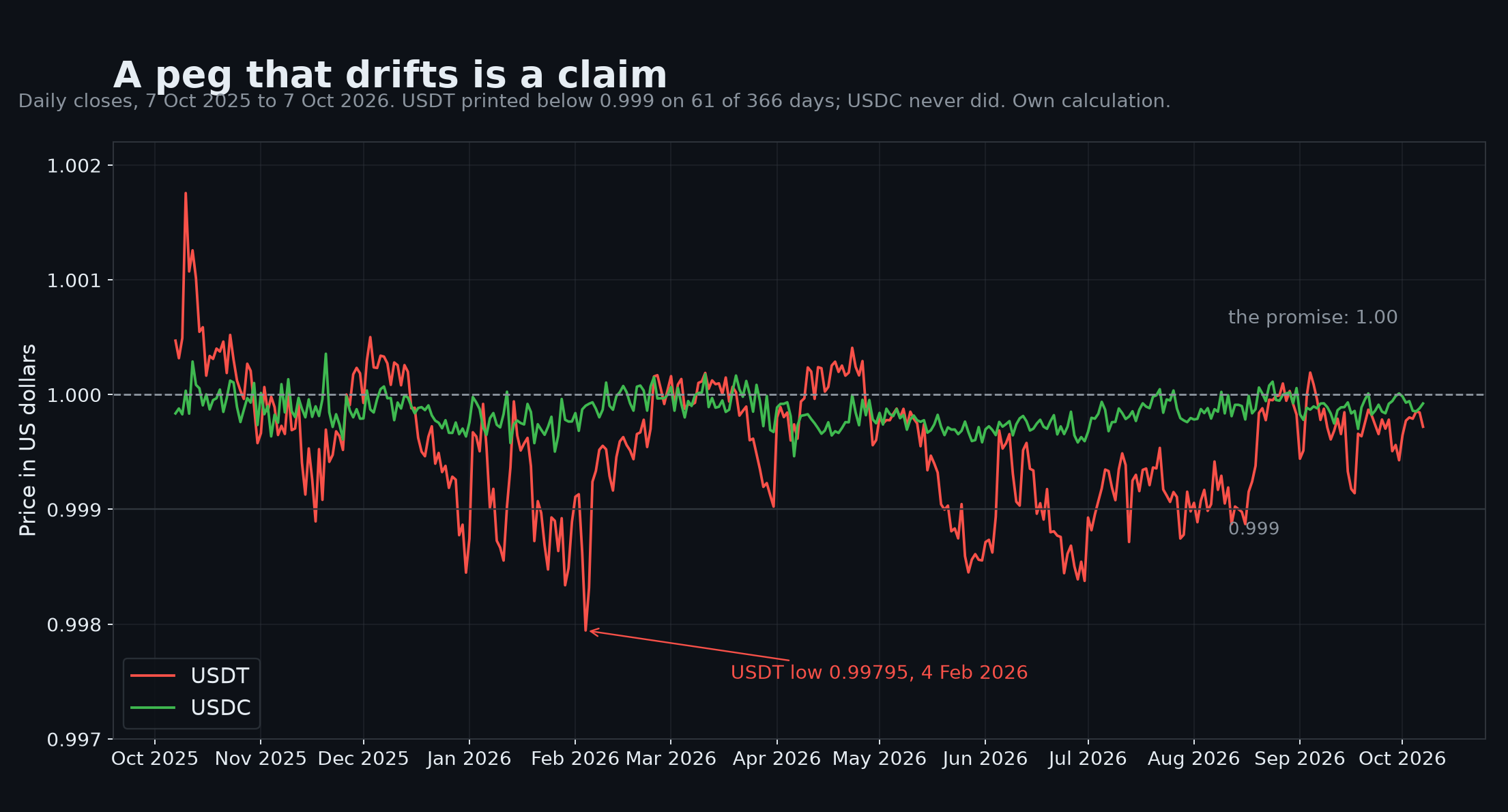
Worth measuring alongside it: the instrument being frozen does not even hold its own peg tightly. Over the past 366 days, USDT closed as low as 0.99795 dollars. That is a fifth of a percent below the promise, and the token printed below 0.999 on 61 of those days. USDC's worst close was 0.99946 [own calculations, Yahoo Finance daily closes, 7 October 2025 to 7 October 2026]. A claim that drifts twenty basis points is still a claim. A claim that can be switched off for a year by a decision with no judge in it is a different instrument wearing the same ticker.
Chart. Two lines tracking USDT and USDC against the dollar, daily closes from 7 October 2025 to 7 October 2026. USDT dips to 0.99795 on 4 February 2026 and printed below 0.999 on 61 of 366 days. USDC stays between 0.99946 and 1.00036 and never printed below 0.999. A dashed line marks the promise of 1.00. Own chart, Yahoo Finance daily closes.
Twenty ounces, and the six point eight that remains
Step back from the compliance layer, because the same week produced a cleaner way to see what the alternative actually is. Nik Bhatia published a piece on 6 October built on a single ratio: there are 138 ounces of monetary gold in existence for every bitcoin. He frames it as a choice rather than a forecast. Would you rather own 138 ounces of gold or one bitcoin? At today's ratio the coin buys about twenty ounces, and parity on his gold basket would put bitcoin near 573,000 dollars, which is roughly seven times the current price.
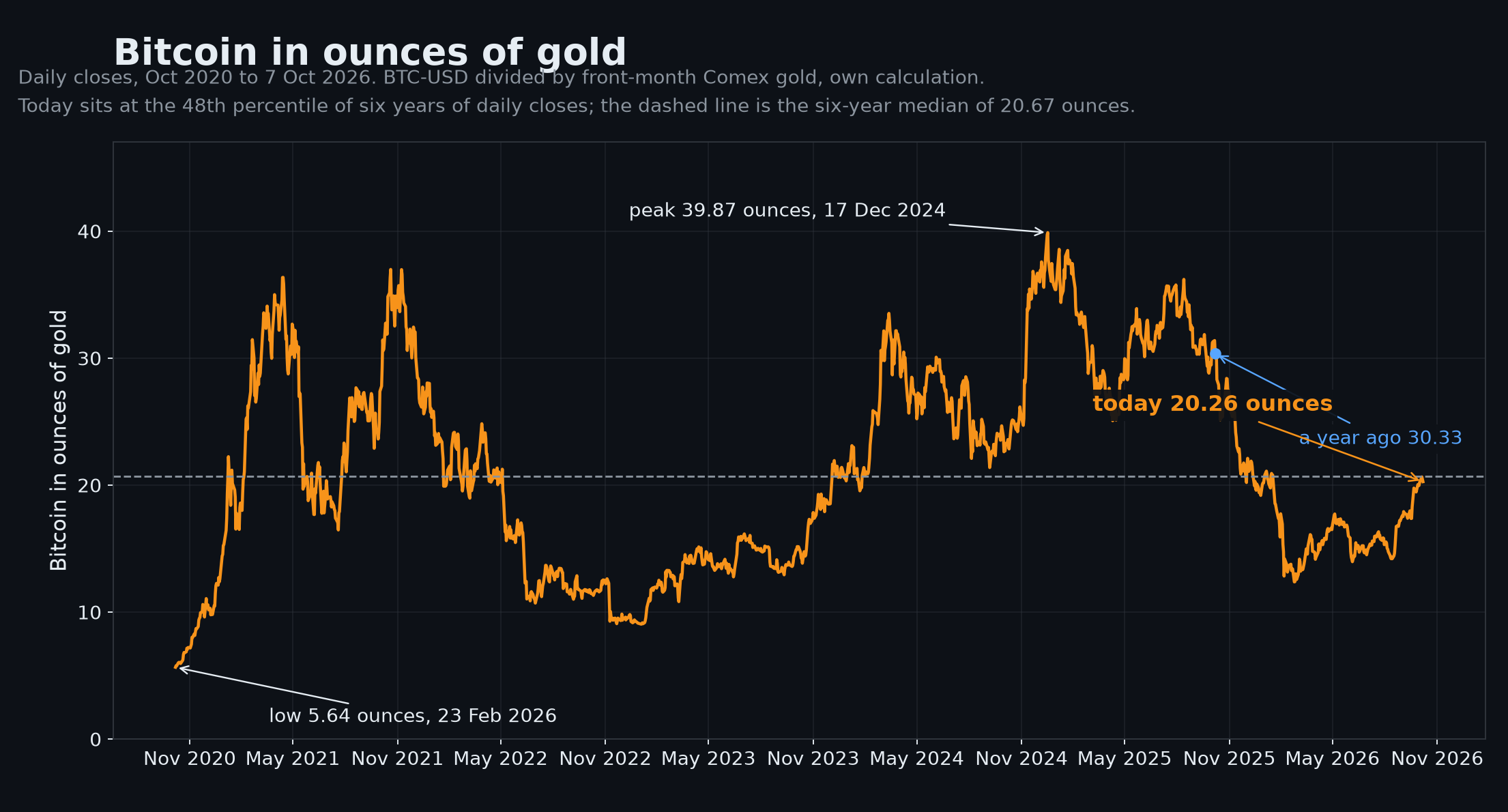
I rebuilt the series to check the tape underneath the claim [own calculation, Yahoo Finance daily closes for BTC-USD and front-month Comex gold, 7 October 2020 to 7 October 2026]. Bitcoin closed at 84,258 dollars on 7 October and gold at 4,159.70, so the coin buys 20.26 ounces. The six-year median is 20.67, which means today is the middle of the range, not an extreme. The peak in the series was 39.87 ounces on 17 December 2024 and the low was 12.37 ounces on 23 February 2026. One year ago the ratio stood at 30.33. Today's level sits at the 48th percentile of six years of daily observations.
The uncomfortable reading for the bulls is the twelve-month one. Bitcoin is down 33.2 percent against gold in a year, having fallen 30.6 percent in dollars while gold rose 3.9 percent. From the February low the coin has gained 65.7 percent against gold, which is the move everyone is talking about, and it is a recovery from a 23-month low rather than a breakout. Both statements come from the same series and both are true.
Chart. Bitcoin priced in ounces of gold, daily closes from October 2020 to 7 October 2026. The line peaks at 39.87 ounces on 17 December 2024, falls to a low of 5.64 ounces at the start of the series in October 2020, falls again to 12.37 ounces on 23 February 2026, stood at 30.33 ounces a year ago, and ends at 20.26 ounces today. A dashed line marks the six-year median of 20.67 ounces. Own chart, Yahoo Finance daily closes for BTC-USD and front-month Comex gold.
The interesting number is not the ratio, it is the 138, because a ratio of 138 ounces reads like a measurement of bitcoin's scarcity when it is really a measurement of how much gold you decide to count.
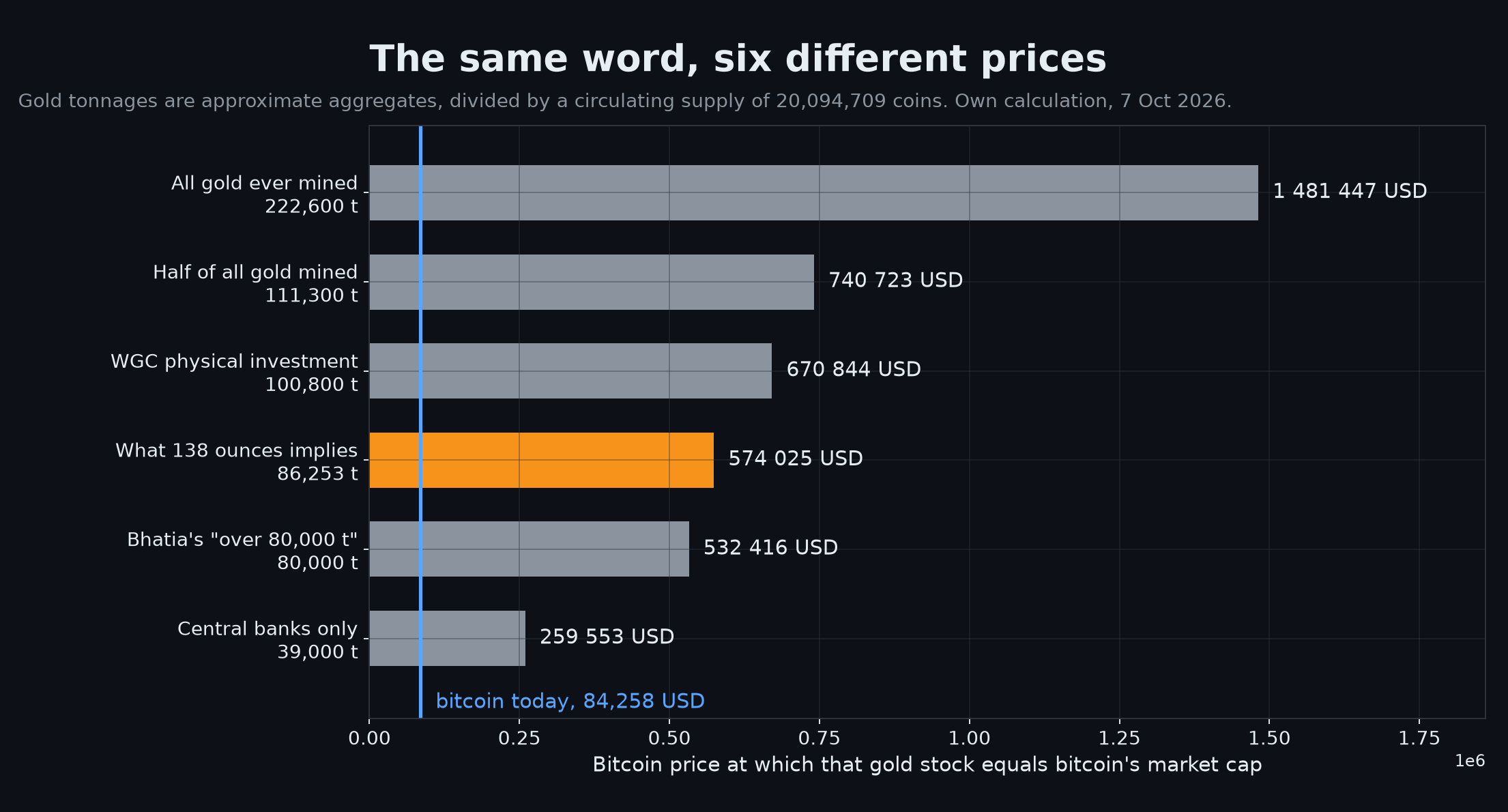
Take the circulating supply. Bitcoin's issuance schedule implies 20,094,709 coins in existence as of 7 October 2026. That figure starts from the chain height of 970,307 published by mempool.space, then adds this epoch's minted coins at 3.125 per block to the 19,687,500 that existed before the last halving [own calculation from the published block schedule and the published chain height]. Dividing gold stocks by that number gives the ratio directly. Bhatia's "over 80,000 tonnes" produces 128.0 ounces per coin. To get 138 you need 86,019 tonnes of gold. Working the same sum the other way, 138 ounces per coin implies a gold stock of 86,253 tonnes at today's circulating supply. Either way the denominator behind the headline sits closer to 86,000 tonnes than to the 80,000 he states, and the difference is not cosmetic: it moves the implied parity price from 532,416 dollars to 574,025 for the two readings. I could not resolve which figure he used, and I say so below.
The spread gets wider when you widen the basket. At today's gold price, the World Gold Council's central-bank holdings of about 39,000 tonnes imply 259,553 dollars per coin for parity. Physical investment holdings of roughly 100,800 tonnes imply 670,844 dollars. Bitcoin capturing half of all gold ever mined, some 111,300 tonnes, implies 740,723 dollars. Matching every above-ground tonne, 222,600 of them, implies 1,481,447 dollars. That is a factor of 5.7 between the narrowest and the widest definition of the same word. The debate about whether bitcoin has "caught up with gold" is mostly a debate about which column of that table the speaker had in mind.
Chart. Horizontal bars showing the bitcoin price implied by six different definitions of the gold stock. Central banks only, 39,000 tonnes: 259,553 dollars. Bhatia's over 80,000 tonnes: 532,416 dollars. What 138 ounces implies, 86,253 tonnes: 574,025 dollars. WGC physical investment, 100,800 tonnes: 670,844 dollars. Half of all gold mined, 111,300 tonnes: 740,723 dollars. All gold ever mined, 222,600 tonnes: 1,481,447 dollars. A vertical line marks bitcoin's price today of 84,258 dollars. Own chart, 7 October 2026.
The case against my own argument
The honest version of the other side is stronger than the version its critics usually dismiss. Tokenised securities, funds and stablecoins do not settle on a network with no rules if institutions are going to hold them. The institutions are going to hold them, because the alternative is that the business stays in the offshore dollar system where nobody supervises anything. Sanctioned entities, stolen funds and payment fraud are real, and a system in which a court order can actually be executed against a bearer token is a feature for the victim of a theft. Spain's housing market is genuinely broken in ways that hurt renters first, and telling a tenant that retroactive protection is philosophically impure is not an argument she can pay rent with. The BIS and the IMF are not wrong that programmable assets make certain markets cheaper to run.
Grant the whole case and one asymmetry survives. Every power that can freeze an issued token is exercised at the discretion of the party that wrote the rules. The record of this week shows what that discretion looks like in practice. A year-long freeze with no order, no notice and no recourse. A chain standard whose seizure authority each issuer defines for itself, in rules holders are told to read before they hold anything. The rulebook may be public, but the trigger is not, and there is no appeals window. That is the trade being offered, and it is being offered while the pegged instrument underneath it drifts twenty basis points below its promise.
What I could not verify
One check belongs at the head of this section rather than its foot. The collecting script scanned all fourteen source articles for text addressed to the machine reading them, instructions, prompts, links to follow. It found none, in any of the fourteen. Every source used here is listed by name in the text.
I did not read the Cardano Foundation's press release, and I did not read the CIP-0113 specification. The BIS and IMF framing, the CMTAT equivalence, the unfracking mechanism and the Gregaard quote all come to me through tftc's account of the announcement. They should be checked against the primary documents before anyone relies on them.
I could not reproduce Bhatia's 138 ounces from his own stated "over 80,000 tonnes", as described above. Neither could I determine which gold stock or which coin supply he used. My own figures for circulating supply and for the gold aggregates are labelled as calculations, not measurements, and the World Gold Council tonnages are approximate figures I did not verify from a primary WGC table.
The Spanish listing pullback numbers, roughly 2,900 units in four hours and a 20 percent drop in Madrid, are unaudited directional counts from Spanish media. The inflation figure of 4.9 percent is Spain's INE flash estimate for September, which is a preliminary number. Junts's stated reason for voting against the decrees is reported, not something I can confirm from the floor record.
On the stablecoin suit I have read tftc's detailed write-up, not the complaint itself. The 2.76 million figure, the freeze date, the Onix timeline and the Brazilian confirmations are all from that account. The same applies to the Thai complaint and its 42.4 million. Tether had not publicly responded as of 6 October.
What the week actually settled
Put the three stories in a line and the shape is clear. Spain showed that a contract can be rewritten by decree and re-approved by a smaller room when the bigger one votes it down. Cardano showed that a bearer token can carry the issuer's authority with it, enforced at every transfer, without the holder ever being asked. Tether showed what the exercise of that authority looks like when it goes wrong: 378 days, no order, no notice, and the float income still accruing to the party that froze the money.
None of that makes bitcoin's price. What it does is define what is being priced. Bhatia's 138 ounces is the number to keep in view. Not because the target is near, but because the gap is 6.8 times, and because every piece of this week's news is an argument about who gets to define the unit in between. Spain is trying to define what a rental contract is. Cardano is trying to define what a token is. Tether has already defined what a USDT is, and a federal judge in Manhattan is about to say whether that definition has limits. Bitcoin's contribution to the argument is narrow and unglamorous: it is the one claim in the story whose terms cannot be edited after the fact by a board, a foundation or a cabinet at three in the morning. That property usually looks like a technicality. It stops looking like one in the week the rules move.