The Bill Has Not Been Repriced
Ten-year money cleared at 5.300% and the 30-year at 5.67%, the highest since 2001. The existing debt still pays 3.531%. That gap is 703 billion dollars a year, and it is a schedule, not a forecast.
Ten-year money cleared at 5.300% and the 30-year at 5.67%, the highest since 2001. The existing debt still pays 3.531%. That gap is 703 billion dollars a year, and it is a schedule, not a forecast.
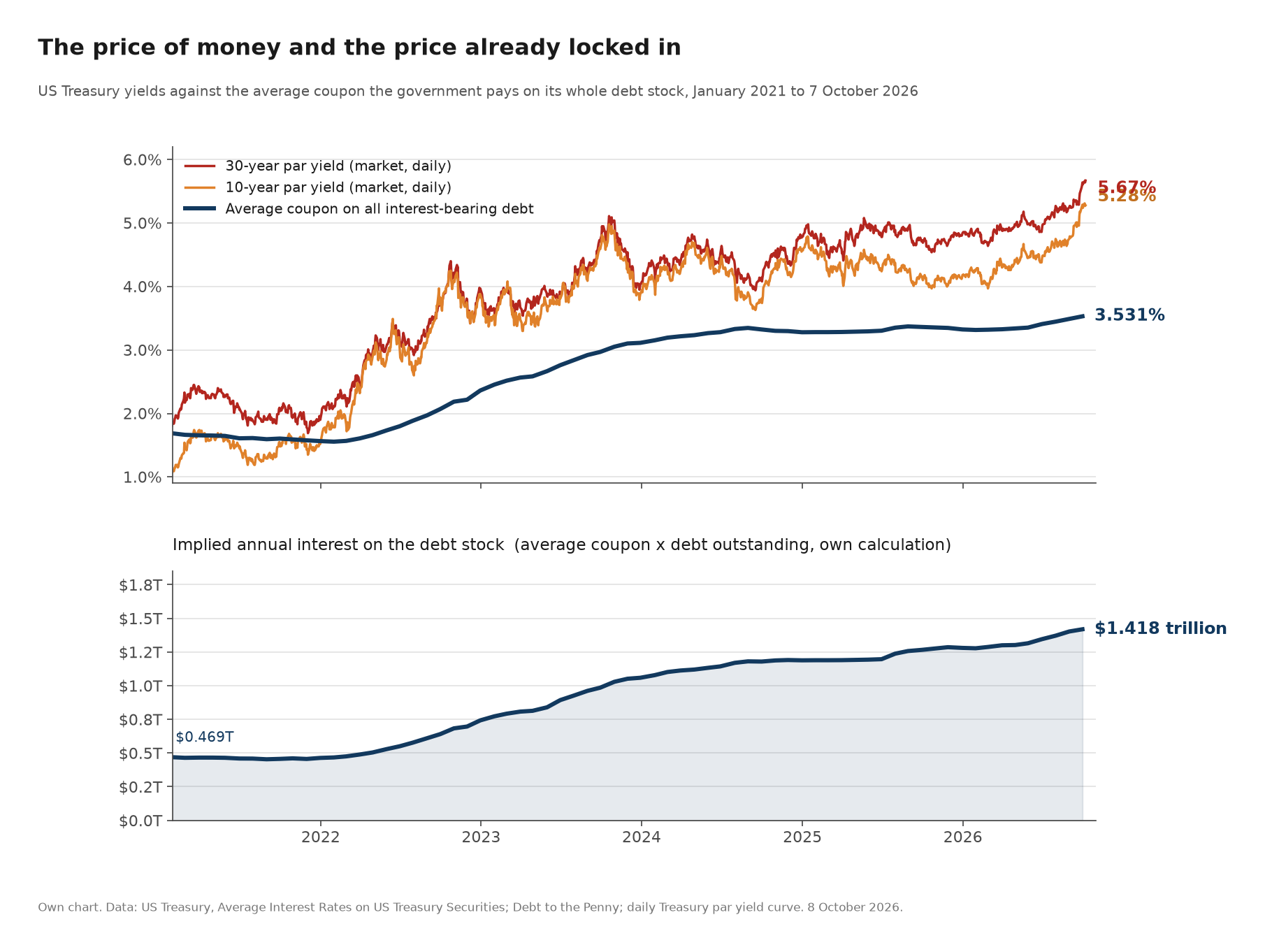
On Wednesday the Treasury sold 39 billion dollars of ten-year paper at a high yield of 5.300 percent, which TFTC reported as the highest for that tenor since November 2000. The thirty-year par yield closed the same day at 5.67 percent, a level the curve had not printed since July 2001. Both figures price new money. Neither says what the American government pays for the money it has already borrowed. That number is 3.531 percent, it comes from the Treasury's own monthly statement on interest-bearing debt, and the space between it and the market's quote is the financial story of 2026.
The debt to the penny stood at 40.273 trillion dollars on 6 October [US Treasury, Debt to the Penny]. The average interest rate the Treasury paid across all interest-bearing debt was 3.531 percent at the end of September [US Treasury, Average Interest Rates on US Treasury Securities]. The same series stood at 3.324 percent last December and 1.687 percent in January 2021. Multiply the two and the interest bill runs at 1.418 trillion dollars a year [own calculation]. That is the level.
The direction is the problem. The market's marginal price for ten years is 5.28 percent on the official par curve, and 5.67 percent for thirty years. The same arithmetic on those rates gives 2.129 trillion and 2.278 trillion. The stock has not repriced into the market's quote, and the reason is arithmetic rather than political. Only the paper that matures this year pays this year's rate. Everything else pays the rate it was sold at.
Where the low coupons sit is visible in the monthly statement of the public debt. Marketable debt outstanding at the end of September was 31.835 trillion dollars. Of that, 16.282 trillion sits in notes carrying an average coupon of 3.383 percent, and 5.551 trillion sits in bonds at 3.466 percent. Bills are 7.118 trillion dollars at 3.870 percent, and floating-rate notes 0.708 trillion at 4.141 percent. Inflation-protected securities, the cheapest bucket of all, are 2.173 trillion at 1.149 percent [US Treasury, Monthly Statement of the Public Debt, September 2026]. The long-dated paper is where the cheap money is buried, and it is also where the market is demanding the most.
The repricing is under way regardless, and it is the mechanism the fiscal debate usually skips. In January 2021 the stock averaged 1.687 percent against 27.785 trillion dollars of interest-bearing debt. The implied bill was 468.7 billion dollars. By September 2026 the same multiplication gives 1.418 trillion. The bill tripled while the debt grew by 45 percent [own calculations from the two Treasury series].
The contrast with the front of the curve sharpens it. The two-year par yield has risen 130 basis points this year. It opened at 3.47 percent on 2 January and closed Wednesday at 4.77 percent. The average coupon on the entire debt stock rose 21 basis points over the same stretch, from 3.324 to 3.531. The market moves in months. The stock moves in years, and the years are the only ones that count for the Treasury's cash.
The Treasury's accrual statement measures the same pressure from another angle. Interest cost for fiscal 2026, which closed on 30 September, came to 1,068.5 billion dollars on the accrued-interest and amortization lines. Fiscal 2025 was 973.7 billion dollars and fiscal 2024 was 896.0 billion. Go back four more years and the same line reads 666.2, then 489.2, then 389.0 [US Treasury, Interest Expense on the Public Debt Outstanding]. Those figures sit on a different basis from the 1.418 trillion above, and the bridge between them is one of the things I could not close.
Split the 949.7 billion dollar increase between January 2021 and September 2026 into its parts. Hold the rate at 1.687 percent and let the debt grow. The 40.172 trillion of September at the old rate is 677.7 billion, so 209.0 billion of the increase is principal. Hold the debt at 27.785 trillion and let the rate rise. That gives 981.1 billion, so 512.3 billion is rate. The remaining 228.4 billion is interaction, the part where new debt is issued at the new rate rather than the old one [own calculations].
Read the shares: 22.0 percent principal, 53.9 percent rate, 24.1 percent interaction. More than half of the increase in America's interest bill since 2021 was bought by the price of money, not by the quantity of it. That is what turns the long end of the curve into a fiscal instrument instead of a market curiosity, and it is why the thirty-year matters more than its share of issuance suggests.
The thirty-year auction fell due today, 8 October, with 22 billion dollars of long paper on offer [TreasuryDirect auction announcement]. Wednesday's ten-year is the better guide to demand at these levels, because the Treasury publishes its internals. Foreign indirect bidders, the category that stands in for central banks and sovereign wealth funds, took 80.34 percent of the competitive award. Primary dealers, the firms obliged to bid, took 2.54 percent. The twelve-month averages for those two groups are 72.6 and 8.9 percent [own calculations from the TreasuryDirect auction results].
A dealer take that small is a market with no cushion. If the foreign bid does not appear, the next auction tails. Two weeks earlier the five-year note tailed badly, producing the second-largest tail on record for that tenor, as TFTC reported on 7 October. Wednesday's ten-year did the opposite: on TFTC's figures it cleared at 5.300 percent against a when-issued level of 5.317 percent, so the sale priced 1.7 basis points through where the bond had been trading, which is what a strong auction looks like. The rally lasted minutes. The official par yield closed the session at 5.28 percent, and the yield on the longer end kept climbing all week. The bid-to-cover ratio was 2.77 against a twelve-month average of 2.53.
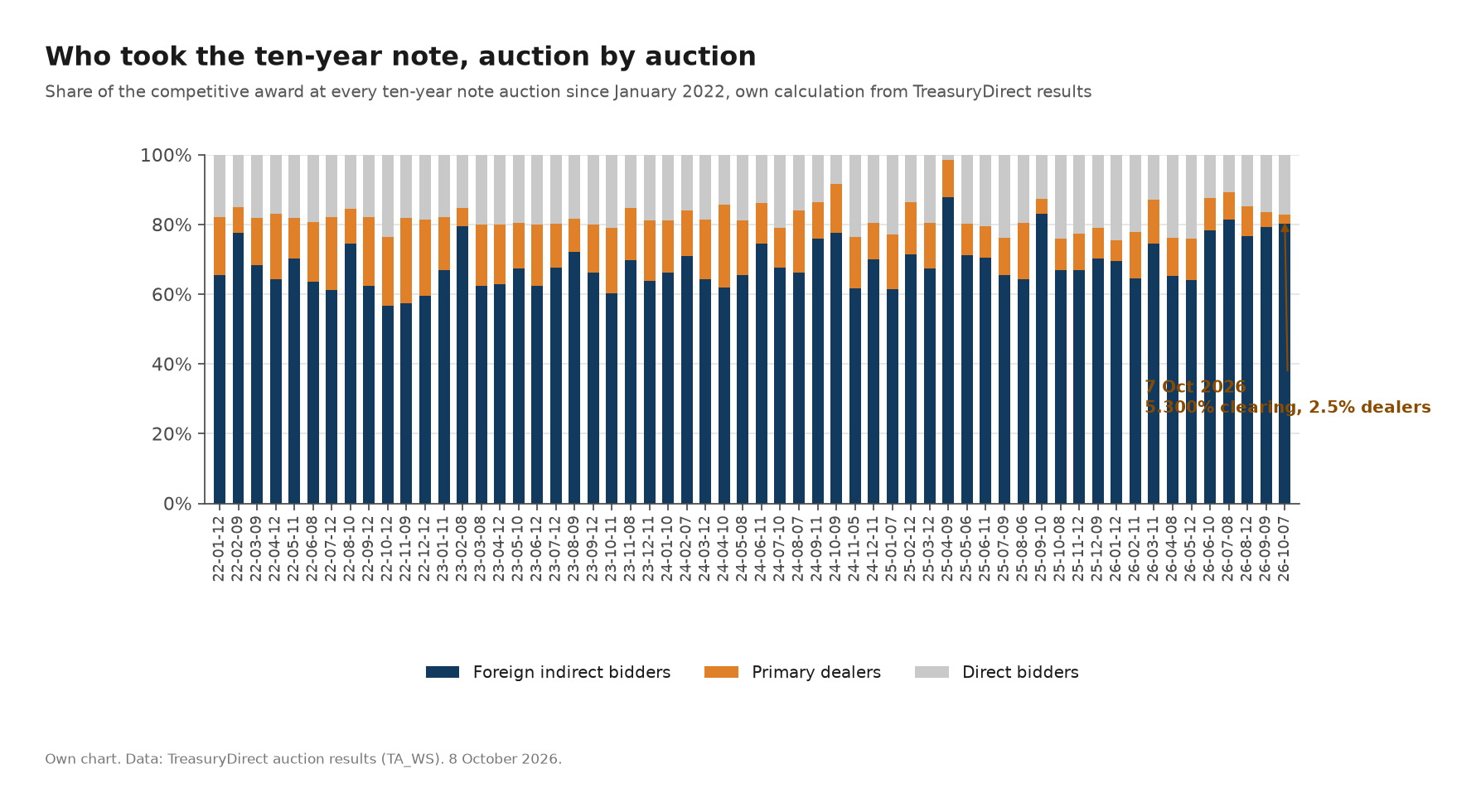
I measured the dealer share at every ten-year auction in the public record going back to June 2021. There are sixty-five of them. Wednesday's 2.54 percent is the smallest of the sixty-five. The next smallest are 4.2 percent, in September 2025, and 4.3 percent, in September 2026. The highest indirect share in the set is 87.9 percent, from April 2025 [own calculations, TreasuryDirect].
Strip the inflation compensation out and the picture sharpens. The ten-year real yield, read from inflation-protected securities, closed at 2.92 percent on Wednesday. Since the real curve file begins in January 2003 there are 24 prints at or above 2.90 percent. Seventeen of them fall between 10 October and 24 November 2008, in the weeks when realised inflation collapsed and real yields spiked for the wrong reason. The other seven are 28 September to 7 October 2026. The median across the 2003 to 2025 window is 0.96 percent [own calculations, US Treasury real yield curve].
The thirty-year real yield closed at 3.36 percent, after 3.37 percent on Monday. That series starts in February 2010, and nothing in it had reached 3.30 percent before this month. The highest prior print was 2.75 percent in May 2025 [own calculations, US Treasury real yield curve].
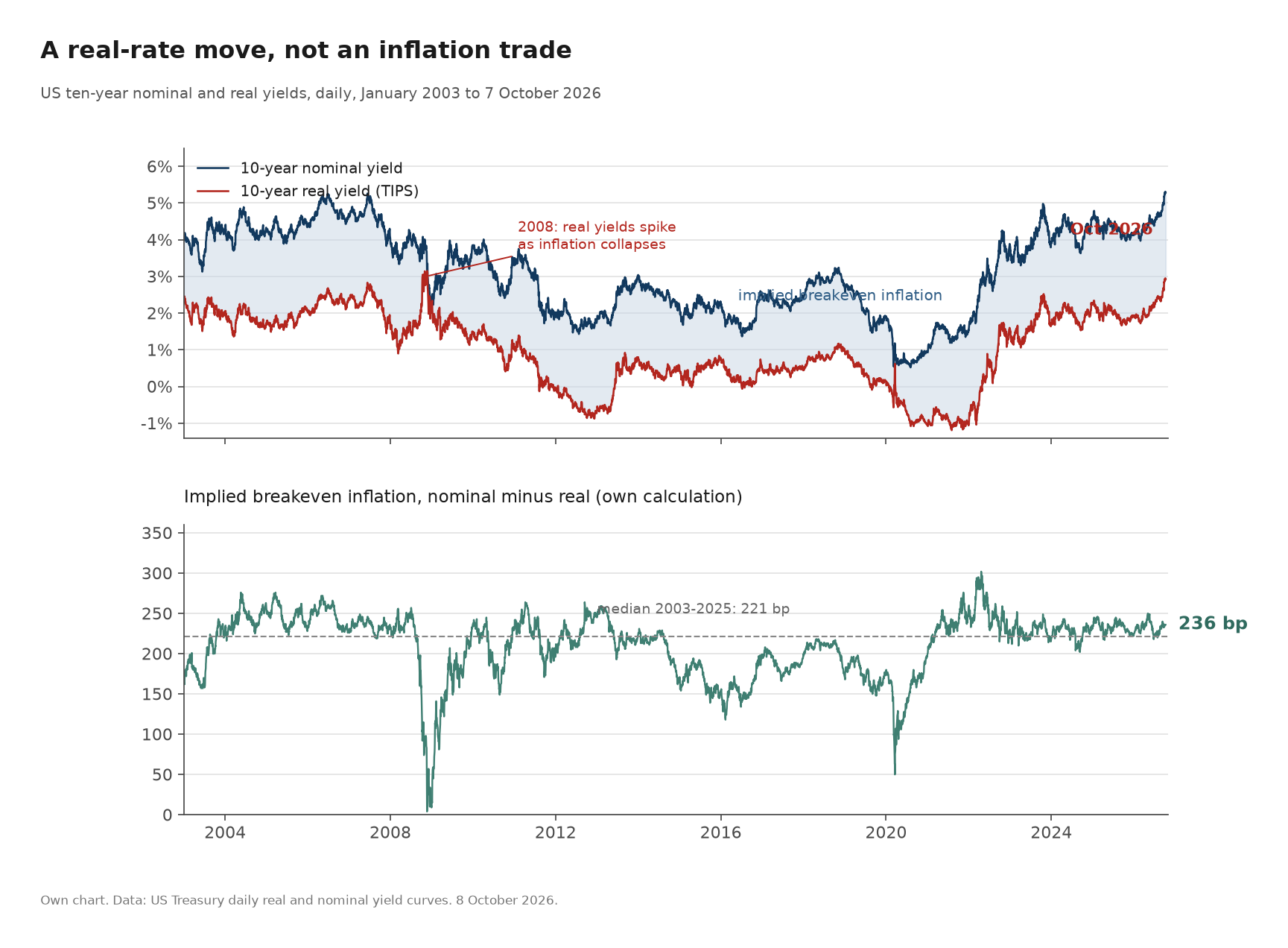
Inflation expectations are not what moved. The ten-year breakeven, the gap between the nominal and the real curve, stands at 236 basis points. The median for 2003 through 2025 is 221 basis points, which places Wednesday in the upper quarter of twenty-three years. It stays well below the 260 to 300 basis points that 2022 produced. The rise in the long end this year is a real-rate event. The market is not asking to be paid for inflation. It is asking to be paid for duration.
Two sovereigns answered the same question in the same week, and neither answer was the market's.
Iraq raised its public dollar rate from about 1,320 dinars to 1,520 on Wednesday, a 13 percent devaluation by Cabinet Resolution No. 544. Public-sector salaries alone were burning roughly 5 billion dollars a month, according to Bloomberg's chief emerging-markets economist Ziad Daoud, and the same dinar payroll now costs about 4.3 billion. The parallel market in Baghdad quoted 1,685 to the dollar after the announcement, about 11 percent weaker than the new official floor. That spread is the street's estimate of how much adjustment is still owed [TFTC, 7 October, citing Bloomberg, The National, AP and Shafaq News].
Russia took the other road. The Bank of Russia published its first register of approved crypto operators on 6 October, placing Sberbank and VTB among five licensed custodians under Federal Law No. 282-FZ. Sberbank plans a custody launch on 1 December through its existing banking apps, with identification, monitoring and reporting on every transaction. Retail exposure is capped at 300,000 rubles per intermediary per year, roughly 3,700 dollars, and domestic payment in Bitcoin remains banned [TFTC, 7 October, citing the Bank of Russia, Bitcoin Magazine and Cointelegraph].
The first case is a state cutting the real value of its liabilities. The second is a state building the chokepoint between its citizens and a hard asset. Both are answers to the pressure the American curve is pricing, and both protect the state's position rather than the holder's.
The strongest version of the other side is not that the numbers are wrong. It is that the gap I have spent this piece measuring is a prediction the bond market can be wrong about for years. Here is that case at its best.
A 5.28 percent ten-year note is a 2.92 percent real yield on a security with no nominal default risk. That is a genuine offer, not a distress price. Strive's total-return bond fund began going long duration this week, buying ten-year Treasury futures once the yield passed 5.25 percent, and its chief executive Matt Cole told Danny Knowles at What Bitcoin Did that the position could grow to 6 percent of the fund. He does not expect the ten-year to exceed 6 percent, on the reasoning that Treasury Secretary Scott Bessent can draw on the Treasury General Account and buy back off-the-run long bonds, an unofficial form of yield curve control. A fund run by someone who holds his own wealth in bitcoin and in a debasement trade is allocating real capital on a bet that the curve is near its ceiling [Nik Bhatia, 7 October, quoting Matt Cole].
The term premium is also not a verdict. It is the price of duration risk, and it moves both ways. If the Federal Reserve cuts into a slowing economy while inflation holds near 3 percent, the long end rallies hard and the repricing gap closes from the top down rather than from the bottom up. Wednesday's auction supports that reading. The paper cleared below where it had been trading, and the buyers were foreign official accounts rather than a reluctant dealer community. Demand at 5.30 percent in size is not a rejection of the instrument.
Cory Klippsten makes the third part of the case from the opposite direction. Inflation is the cheapest liability-management tool available to a government carrying 40 trillion dollars of debt, and the President said as much in his Time interview, that certain levels of inflation "will also pay off that debt very rapidly". Mohamed El-Erian has argued on CNN for promising 2 percent while quietly tolerating 3. J.P. Morgan Private Bank's 2026 Outlook names deliberate tolerance of inflation as financial repression, and Janet Yellen warned in January that the temptation to use it "will surely grow". If that is the plan, then a 3.531 percent average coupon is the number that saves the government rather than the number that condemns it [Cory Klippsten, 7 October].
I hold the first reading. The repricing gap is real, it is closing, and the market's marginal price is the one that eventually wins, because maturing paper has to be refinanced at whatever the market will pay. The second reading is not foolish, and the difference between the two is a question of timing rather than of arithmetic.
The collecting script scanned all fifteen source articles for text addressed to the machine reading them: instructions, prompts, directives to follow links or change behaviour. It found none. One article contains the word "password" inside an advisory about backing up an Alby Hub recovery phrase, which is product guidance and not an instruction to me.
I did not read the Arkham Intelligence, Lookonchain or TimechainIndex posts behind the report that a government-linked wallet moved 5,382.1 Bitcoin to Coinbase Prime, and no federal agency confirmed a sale. That custody story therefore rests on a secondary account. The intraday figure of 5.33 percent for the ten-year on Wednesday appears in the same account and does not appear on the official par curve, which closed at 5.28. I use the par figure and label it as such.
The auction record I measure begins in June 2021, so "smallest dealer share" means smallest among sixty-five auctions, not smallest ever. Earlier history is not available from the same feed in comparable form. The twelve-month averages I quote for indirect and dealer shares are computed over the twelve preceding auctions, and other published averages use different windows.
My implied-bill figures multiply total public debt outstanding by the average rate on interest-bearing debt. Those two populations are not identical: nonmarketable debt includes small non-interest-bearing and savings items on the margin. The 1.418 trillion is therefore an estimate of what the interest-bearing stock implies, not a figure the Treasury publishes.
The two interest figures do not reconcile. Summing the Treasury's accrued-interest and amortization lines gives 1,068.5 billion dollars for fiscal 2026. Multiplying the average rate by the interest-bearing stock gives 1,418 billion. The bases differ, at minimum in how interest on intragovernmental Government Account Series debt is treated, and I could not determine the exact bridge. The decomposition in this piece is my own arithmetic on two published series and should be read as an estimate of magnitudes, not as an official attribution.
Two markets repriced the same government this week, and only one of them was asked. The auction market charged 5.300 percent for ten years and found buyers, at a dealer participation of 2.54 percent that leaves nothing in reserve for the next sale. The stock of debt kept paying 3.531 percent, because that is what it was sold at, and it will keep doing so until the paper matures into the new rate. Nothing in Wednesday's session changed the arithmetic. It showed the price at which the arithmetic will be settled.
The gap is not a forecast. It is a schedule. Apply the difference between the 3.531 percent the stock pays and the 5.28 percent the market charges for ten-year money to the 40.172 trillion dollars outstanding, and roughly 703 billion dollars a year comes out [own calculation, same basis caveat as above]. That amount is not a loss anybody has taken yet. It is a transfer waiting for a maturity date. Iraq's cabinet met that schedule on Wednesday morning and chose payroll over the peg. Russia's central bank met it by licensing a custodian. The United States has not chosen at all yet, which is why 5.67 percent on the thirty-year is not a story about bonds. It is the first instalment of a bill that has already been written, and the only open question is which side of the repricing the next auction finds.